


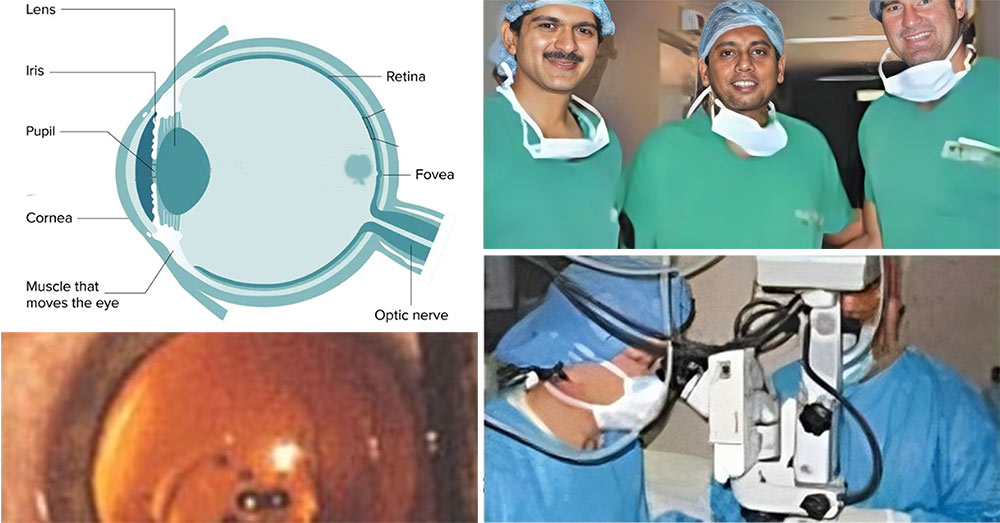
On a normal Thursday afternoon I find myself wearing a patient gown and a face mask, staring at a TV screen at Nawaloka Hospital, Colombo. The screen shows how Dr. Wariyapola is performing a laser eye surgery. Nothing new? No, not really. Laser eye surgeries have been around for a while and are highly popular with people wanting to banish their short-sightedness for good. Usually, these surgeries are performed on patients with up to -8.0D. There is a newer technique however, called Implantable Collamer Lens, a solution for dioptres below -8.0.
People with short-sight, or myopia, have problems with their natural lenses. They contract too hard, with the consequence of having an unclear vision. Normally, this can be corrected by wearing glasses or contact lenses. Of course, this is a temporary solution.
Those who like to change their vision permanently can choose laser eye surgery, also called LASIK. Since February this year, 12 Sri Lankan patients have tried something entirely new and chosen to have a lens placed inside their eyes – the ICL.
ICL involves a short surgical procedure where a small incision is made and a lens is placed just in front of the natural lens inside the eye. The Implantable Collamer Lens (ICL) works together with the natural lens to create normal vision. A big advantage of ICL is the fact that the treatment is reversible. If something goes wrong, the lens can be taken out of the eye. Besides, the recovery is quick after surgery and “there will be a ‘wow-effect’ after the lens is placed”, according to Dr. D. Wariyapola.
ICL was developed in Russia in 1992; the first surgery in the USA was in 2005. It took some years to travel down to Sri Lanka because of cost factors. In India ICL is widely used. With every new treatment, there are risks involved.
Explanis Dr. Wariyapola: “a complication might be an infection in the eye, but that is extremely rare.” According to the statistics so far, 99% of the surgeries are without complications. “I treated the first patient in Sri Lanka and he is very happy with the result.”
So is ICL going to replace laser eye surgery? Dr. Wariyapola: “No, I don’t think so. In my opinion they will co-exist. There are different indications for the two treatments. LASIK is performed on patients with up to -8.0 dioptre. -8.0D to -10.0D is a grey area, where secure measurements have to find out what the better solution will be. After -10.0D, I would recommend ICL. But most patients have a short-sightedness up to -8.0D, therefore LASIK will be more common than ICL.”
Who are candidates for ICL? First of all, you need quite a bit of money to spend as ICL costs around Rs. 120,000 per eye. Some health insurance policies may cover the surgery. Secondly, you need to have a short-sightedness of at least -8.0D. And lastly, according to Dr. Wariyapola, “just like any new treatment, the patient should be convinced of the need and accept the benefits of the treatment. In this case, you can throw away your glasses after the treatment.”
Back in the operation room, a green and red laser light is focussed on the eye. A short beep, lots of liquids and a layer of cells is placed back on the eye. “Done!” Dr. Wariyapola takes a short break before he starts with the second eye. For now, most of the surgeries he will be doing are the laser treatments. The patient, a young girl, sits up and blinks with her treated eye. She smiles. In a month she will see clearly again.